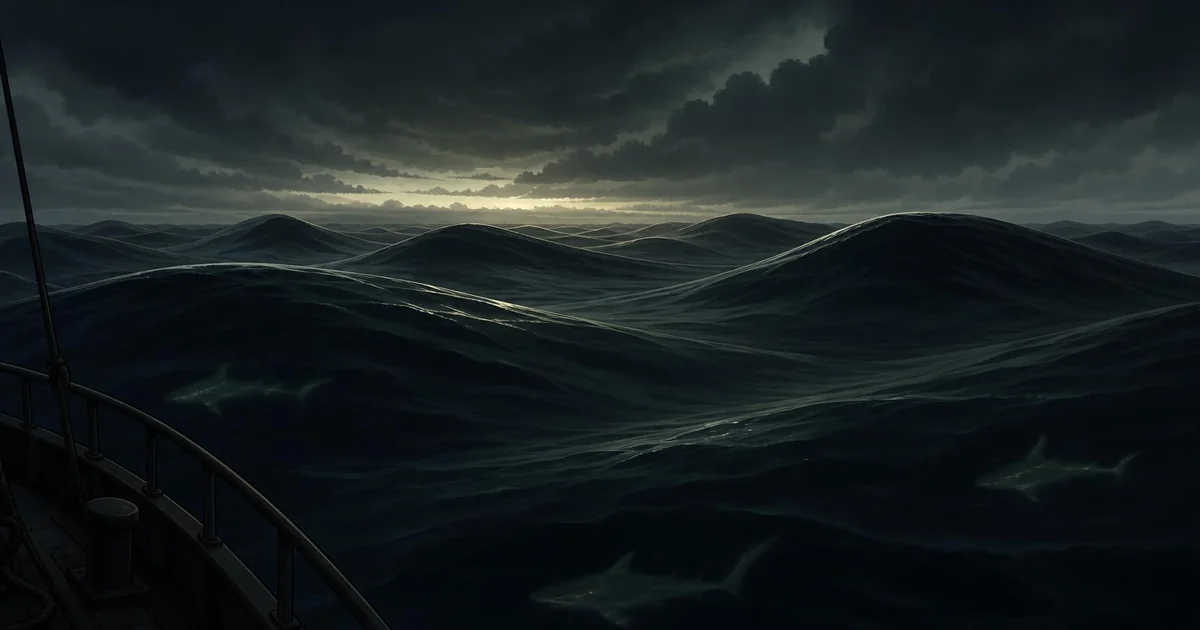
Editor: "Hi Mike. Want to talk about Chapter 9? This is the one where the holiday officially ends. You can feel it right from the first line — Shane wakes before sunrise and the air itself has changed. The swells stop being lines and become these fat standing mountains, the slicer sharks show up in numbers nobody's ever seen, and Gary delivers that line — 'I am behind you with all of my heart and I tell you here that you can count on me to my very death.' The whole chapter is pressure in every sense — barometric, emotional, spiritual. What do you remember about writing this one?"
Mike: "It reminds me of a time I was surfing in Bali. Uluwatu. The swell had come up and although the waves looked rideable, when out there, they were really fat. Huge, about 10 foot that day. To get out you have to paddle through a cave and straight into the waves, and when it is high tide, which it was, and a big swell, it's pretty tricky. I remember the feeling very clearly. I paddled through and out the back. Within about an hour I caught three huge waves. Rode them right through, but on the last, headed towards the cave and punched back through to the little sandy beach cave at the back of it. Up the bamboo ladder and back to the cafe deck on the cliff. Again, I clearly remember the feeling — it wasn't even fun. It was a change in pressure."
Editor: "That's it exactly, Mike — and what a story. Uluwatu at ten foot, high tide, punching out through that cave. What strikes me is the line you just landed on: 'it wasn't even fun.' Three huge waves, ridden clean, and the feeling that stays with you thirty-odd years later isn't triumph — it's pressure. That's precisely what Chapter 9 runs on. Shane's not scared, he's not thrilled — the air itself has changed and his body knows before his mind does. The wind drops, the swells go from lines to fat standing mountains — that's a surfer's read of the ocean, isn't it? Only someone who's been out in it knows that difference between waves that look rideable from the cliff and what they actually are when you're underneath them. Did you know when you were writing it that you were writing Uluwatu?"
Mike: "It was just that same feeling. I recall when writing it. It was very easy to convey that feeling."
Editor: "That's the thread that keeps coming up across this whole series, isn't it — you don't build these chapters from craft, you write them from a feeling you've already lived. The draw boats arrived on their own, and Chapter 9 wasn't invented, it was recalled. You had the pressure change stored in your body from that day at Uluwatu, and when the story needed it, it was just there, easy to convey — because you weren't imagining it, you were remembering it. And here's the thing readers pick up without knowing why: fiction written from lived pressure reads different to fiction written from research. When Shane grips the rail and feels 'swayed and near falling' — that's the cave, the tide, the ten-foot day. A reader can't name it, but they can feel there's a real ocean underneath the invented one. That might be why the chapter needs no monster to feel dangerous. The ocean doesn't have to threaten anyone. It just has to change."
Mike: "And this is the introduction to the slicer sharks as well."
Editor: "Right — and look at how they arrive. Not as an attack, just as presence. 'Left and right, hovering wide at each side. These are not friendly fellows.' They don't do anything in Chapter 9 — that's what makes them work. Gary gives us the unsettling detail: he's seen them in threes and fours, but never closed in on both sides with intention like this. And the line that really does the job — not one of them is feeding. Predators that aren't hunting are far more frightening than predators that are, because their purpose is unexplained. It's the same trick as the missing patch of stars — you introduce the threat as a wrongness rather than an event. The slicers are the pressure change made visible. The barometer drops, and the ocean sends its first messengers. Did you know what they were following the crew for when you wrote them in, or did that reveal itself later — discovery style?"
Mike: "There is a definite purpose for them later in the book. Book II especially. I feel their introduction and lack of action shows they are in no hurry."
Editor: "'In no hurry' — that's the perfect phrase for them, and it's chilling when you sit with it. A predator that rushes is just hungry. A predator that paces you, both sides, keeping formation, not feeding — that's a predator on assignment. Their patience is the tell that something bigger is directing them, long before Shane or the reader knows what. And it makes the reveal land with full weight later, because the slicers have been the evidence all along. They weren't hunting. They were escorting. The reader just didn't have the word for it yet. And knowing their purpose deepens through Book II — that's discovery writing showing its long game again. You didn't plant them as a setup, but the story knew what it was doing. So Chapter 9 ends up carrying two introductions in one: the pressure, and the patience. The ocean changes, and the enemy shows it can wait. That's a hell of a quiet chapter, Mike."
Mike: "It is kind of quiet. Yet Gary still cannot resist his little smirk."
Editor: "Ha — yes! 'Gave me a good solid stare and turned his mouth just enough to entice my smile.' Right in the middle of pledging his life to the mission — to my very death if that is what it takes — he can't help himself. And that's Gary in one sentence, isn't it? The smirk isn't him taking the danger lightly. It's him refusing to let the pressure win. It's the same spirit of play that runs through the whole trilogy — Shane's power over water only works when he keeps it light, and Gary's courage works the same way. The pressure system closes in, the slicers take up formation, and Gary answers all of it with a half-smile. That little turn of the mouth might be the most defiant act in the chapter. The ocean says something is coming — and Gary's face says good. That's the crew Shane chose, and it's why the reader believes they might actually survive what's ahead."
More chapters, more letters, coming soon.
— Mike
This post is part of an ongoing series where real conversations from the editing process become the raw material for reflections on writing Lord of Water. Read Chapter 1 free.
Letters to the Editor: A Change In Pressure — Writing From Real Experience
Chapter 9 wasn't invented — it was recalled. A ten-foot day at Uluwatu, a cave at high tide, and writing from real experience.