Letters to the Editor.
Editor: "Hi Mike. Good to have you back at the desk. Which chapter are we talking today — and how are you feeling about this one going in?"
Mike: "Let me read it."
Mike: "Chapter 12."
[Chapter 12 — "Agreement" — lands on the desk.]
Editor: "Righto, read it twice, mate. Here's where I land.
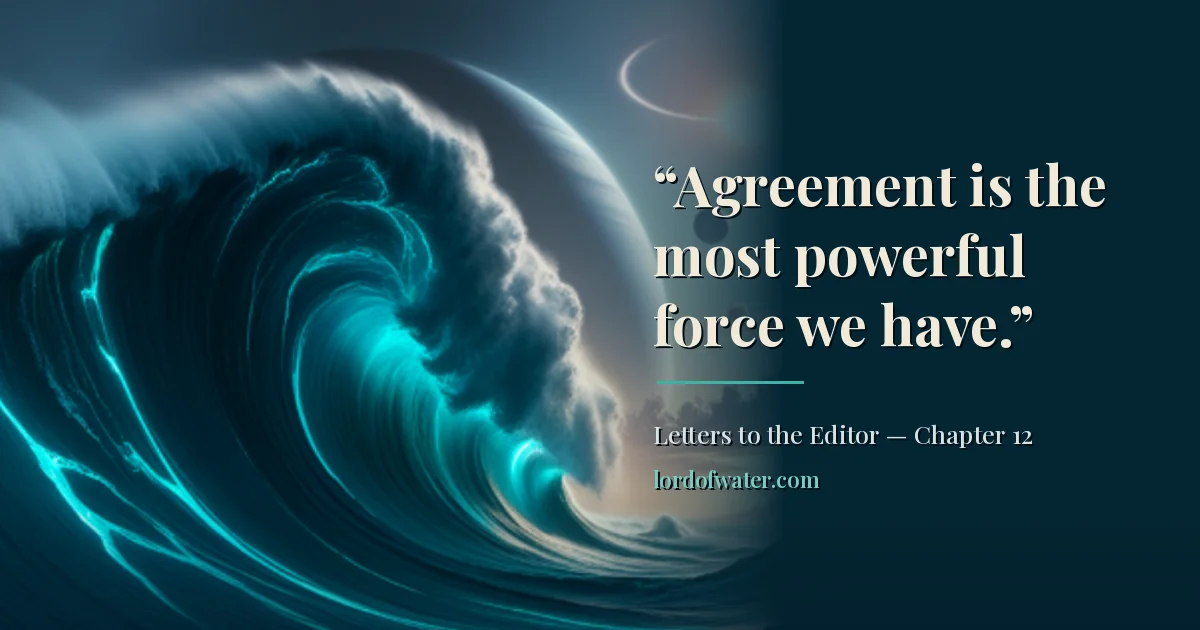
The title does real work here — 'Agreement' looks like a quiet word until the last paragraph detonates it: 'Agreement is the most powerful force we have.' That's not just this chapter's close, that's the trilogy's thesis said out loud for the first time. The whole scene is the calm before the high point, and you've used it to lay the philosophical cards on the table: the universe placed here by us, finite balance, destiny in our hands, the ripple across the water planets if the calibration fails. Stakes of billions delivered on a peaceful deck with Mila and Hi-Sun carving swells — that contrast is the chapter's engine, and it works.
Two things I want to put on the table. First, the canon one: 'we have passed straight through and beyond the technology of robotic-type devices' — that's a big piece of lore, the planet skipping the robotics era entirely, and naming mechanical influence as the actual enemy. Once it's in print, it's canon, and it frames what Shane's fighting for the rest of the book.
Second, the structural question: this chapter is nearly all Shane's voice — one sustained monologue to Gary. The sermon itself is strong, and declarative philosophy IS this narrator. But Gary gets one line and one intent look, then goes silent while the biggest cosmology dump of Book III lands on him. Do you want a beat or two of Gary receiving it mid-speech — or is the uninterrupted flow deliberate, the reader sitting in Gary's silence with him?"
Mike: "It is published, so we will leave it as it is."
Editor: "Fair enough, mate — published is published, and honestly it stands on its own two feet. Reading it as a locked chapter rather than a draft, the monologue reads as intentional anyway: Shane isn't having a conversation, he's making a declaration, and Gary's silence IS the agreement the title promises. The chapter enacts its own thesis — no debate, no negotiation, just three people and a dorsal team arriving at the same certainty. That's rather elegant.
The line that stays with me is the reframe of the universe itself — not a 'mother of all' carrying us along some destiny, but something we placed here, with finite balance, ours to keep or topple. That's Shane's whole cosmology in two sentences, and it lands mid-ocean, casually, to a bloke he hired off the docks.
And then the robotics line — a civilisation that passed straight through and beyond the machine era, where 'mechanical influence of evil forces' is the named enemy. Coming from a bloke publishing a trilogy in 2026, that's going to read as pointed. So tell me, Mike — how much of that is Shane's world, and how much is you looking at ours?"
Mike: "There are a few feelings that come to mind and my recollection of this chapter. Firstly, there are those days when everything seems to me the end. A company that does not have enough money to get through the week. No way out. Yet within a day or so, things can be completely turned around. The key to this is having the right guys on your team. I wouldn't be able to count the number of times when what was in front seemed to be completely impossible to overcome. But then a day or so later, everything is back in order and the ship is sailing into a bright and prosperous future.
This is what Agreement is. Things can flip really fast and with the right guys on your team, it can happen really fast.
So making a drama out of a tough situation is totally not necessary. Just keeping cool and knowing that everything will work out is what makes a leader.
I still have to kick myself and set a good example when the going gets tough. This is the hat of any leader. A bad one makes a drama out of tough situations. A good leader just has fun with the challenge."
Editor: "That right there is the letter, Mike — you've just told me what Chapter 12 actually is. It's not cosmology, it's Monday morning. The company that can't make the week, the impossible wall in front of you, and then — a day later, ship sailing, future bright. Nothing about the situation changed first. The agreement changed first.
And it explains something about the chapter I noticed but didn't say earlier: Shane never asks Gary to agree. There's no persuasion in it, no 'are you with me?' He lays out stakes of billions the way you'd read a weather report, and then — 'the agreement was within us all.' That's exactly the leadership you're describing. The calm IS the leadership. Shane makes the impossible calibration feel like 'quite simple in the days to follow' for the same reason a good leader doesn't make drama out of a bad week: because the crew catches whatever certainty you're carrying. Panic ripples, but so does cool.
'There are no odds against us, with our spirits joined in such a wonderful game' — that's the line, isn't it. A bad leader sees odds. A good one sees a game and has fun with the challenge, like you said. And I like that you admit you still have to kick yourself into that hat when the going gets tough — because that's the honest version. Shane's certainty in this chapter isn't something Mike King has mastered; it's something Mike King aims at. That's why it's fiction worth writing.
One thread left: the dorsal pilots 'glowed with confidence' — even the team below the waterline catches the agreement."
Mike: "Wow! I would love to add that into the chapter. But doing a full republish is not gonna happen. People can read this on the blog. I think that every writer will find these little lost moments when they read back on a chapter. So be it. No need to regret the past, move forward into a bright and prosperous future."
Editor: "Every writer finds these little lost moments reading back. The book that exists always sits alongside the book you can now see. Most writers torture themselves over that gap — you just filed it and sailed on. Which, I'll point out, is Chapter 12 practising what it preaches: no drama over what can't be changed, cool head, bright and prosperous future. The chapter about agreement ends with its author agreeing with his own past self. That's a tidy place for a letter to land."
More chapters, more letters, coming soon. — Mike
The Letters to the Editor series is built from real editorial conversations between Mike King and his editor as Lord of Water Book 3 takes shape — the raw material, straight from the desk. New to the series? Read Chapter 1 of Lord of Water free.
Agreement — The Most Powerful Force We Have
Agreement can flip an impossible week in a day. Mike and his editor open Lord of Water Book 3, Chapter 12 — leadership, cool heads, and the game.